
Russia's Tatneft invests TRY 17 billion in a major petrochemical project
Russia's Tatneft invests TRY 17 billion in a major petrochemical project
Türkiye’s first maleic anhydride plant has started production in Dilovası following a TRY 17 billion investment by Tatarstan-based Tatneft. By meeting 90% of Türkiye’s needs and replacing TRY 3 billion worth of imports, the facility is seen as the most concrete step towards overcoming the slowdown in trade between the two countries through a “local production” model.
Türkiye has taken a historic step towards reducing its dependence on foreign suppliers in the chemical and petrochemical industries.
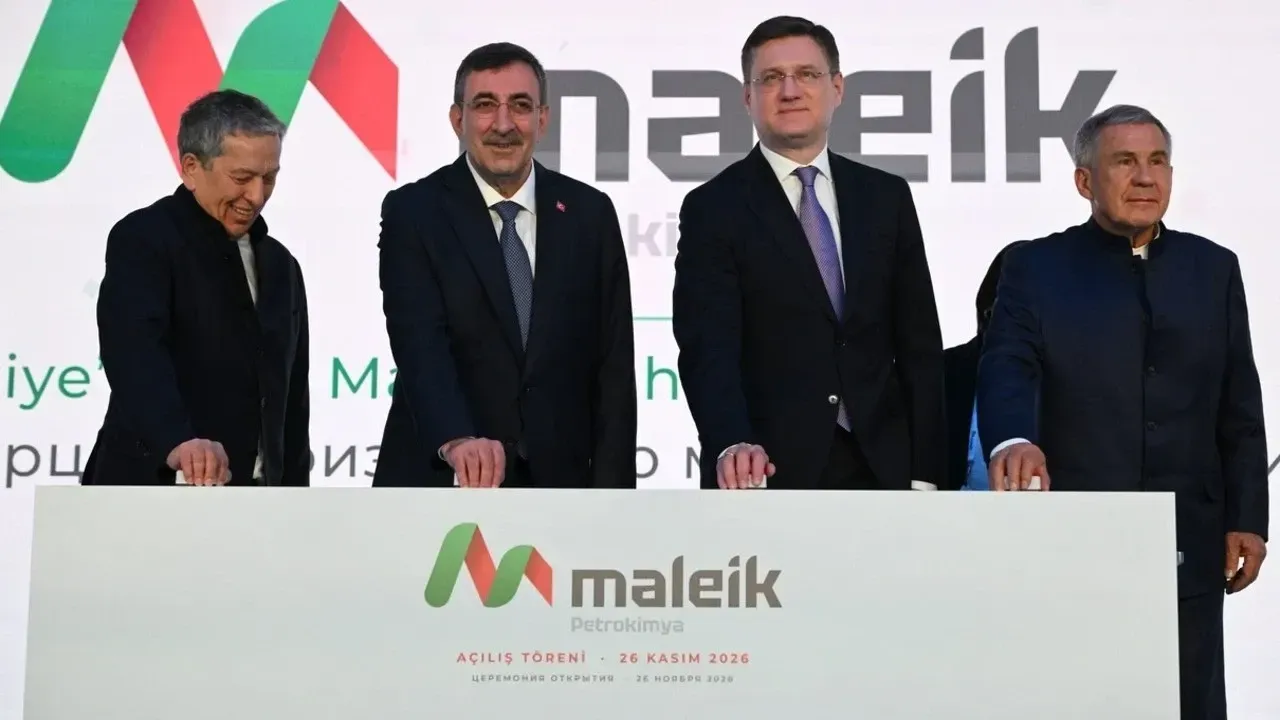
The facility, established by TN Maleik Petrokimya, a subsidiary of Tatneft, the petrochemical giant of the Republic of Tatarstan within the Russian Federation, is located in the GEBKİM Chemical Specialised Organised Industrial Zone in Dilovası, Kocaeli. It was officially inaugurated at a ceremony attended by senior government representatives.
The inauguration ceremony was attended by Turkish Vice President Cevdet Yılmaz, Russian Deputy Prime Minister Aleksandr Novak, President of the Republic of Tatarstan Rustam Minnikhanov, Minister of Industry and Technology Mehmet Fatih Kacır, Minister of Trade Prof. Dr. Ömer Bolat, and GEBKİM Chairman of the Board Vefa İbrahim Aracı.
Until now, maleic anhydride had been entirely imported from abroad, primarily from China. For the first time, it is now being produced in Türkiye on an industrial scale.
With an annual production capacity of 50,000 tonnes, the plant will be able to meet approximately 90% of Türkiye’s demand for liquid maleic anhydride, estimated at between 55,000 and 60,000 tonnes per year.
A strategic move to reduce the foreign trade deficit
Speaking at the ceremony, Vice President Cevdet Yılmaz highlighted the foreign trade deficit in the petrochemical sector, recalling that Türkiye recorded USD 4.4 billion in exports against USD 17.4 billion in imports in 2025.
“We consider reducing our dependence on foreign suppliers for critical inputs to be a strategic priority. With this investment of TRY 17 billion, we will meet most of our needs through domestic production. Furthermore, converting the heat generated during production into electricity is extremely valuable in terms of our green transition objectives,” he stated.
Minister of Industry and Technology Mehmet Fatih Kacır also emphasised that the chemical industry was Türkiye’s second-largest exporting sector last year, with exports reaching USD 32 billion.
Noting that the investment had received support under the project-based incentive scheme, Kacır described it as an example of industrial clustering.
“More than 70% of the products manufactured at this facility will be further processed in factories within GEBKİM and transformed into high value-added finished products,” he said.
Minister of Trade Prof. Dr. Ömer Bolat announced that Türkiye had spent approximately USD 420 million on maleic anhydride imports over the past five years.
Noting that annual trade volume between Türkiye and Russia had reached USD 50 billion, Bolat stated that the new facility would directly contribute to reducing the current account deficit and increasing qualified employment in the region.
New investment signals from Moscow and Kazan
Russian Deputy Prime Minister Aleksandr Novak stated that the facility was a concrete outcome of the commitment expressed by Turkish President Recep Tayyip Erdoğan and Russian President Vladimir Putin.
He reported that initial production had taken place in September and that quality tests had been successfully completed.
“The active involvement of Turkish engineers and contractors in the project’s design and construction demonstrates mutual trust. We also aim to deepen our cooperation in the production of finished goods,” he said.
President of the Republic of Tatarstan Rustam Minnikhanov noted that the TRY 17 billion facility, whose foundations were laid in 2021, represented Tatarstan’s largest investment in Türkiye.
“Completing this investment at a time when the global economy is going through a challenging period is a major achievement. We hope to bring Turkish businesspeople to Tatarstan and Tatarstan-based investors to Türkiye for new joint projects,” he stated.
From buttons to automotive components: a material used across industries
Once operating at full capacity, the maleic anhydride plant will replace approximately TRY 3 billion worth of imports annually.
Maleic anhydride is a key input in the manufacture of many everyday products. It is particularly used in the production of unsaturated polyester resins and is involved in a wide range of industrial applications, including automotive components, construction and building materials, composite products, paints, varnishes, adhesives, and textile components such as buttons and zippers.
Local sourcing is expected to help manufacturers reduce logistics costs and accelerate inventory planning.
The Facility Will Create More Than 120 Jobs
Equipped with environmentally friendly production technologies, the plant also manages its energy costs internally.
The high levels of heat generated during the chemical reaction are recovered and converted into steam, which is then used to generate electricity through turbines installed within the facility.
The system has an installed capacity of 15,000 kW and can generate approximately 127 million kWh of electricity per year.
With this capacity, the plant will meet all of its own energy requirements while feeding surplus electricity into the national grid, thereby making an additional contribution to the economy.
The facility will directly employ more than 120 skilled workers and will also provide a foundation for the development of petrochemical expertise that was previously unavailable in Türkiye.
Taking advantage of GEBKİM’s proximity to road and maritime transport links, TN Maleik Petrokimya will initially focus on meeting domestic market demand.
In the medium and long term, the company’s roadmap includes exports to neighbouring markets, particularly European countries.
***
Source : Ekonomim, November 27, 2026. Article translated by Advantis Conseils Turquie